Pages

Saturday, March 30, 2013

Dividing Paper Puzzle


When I was young, I would fold a sheet of letter paper in half, for origami projects. It occurred to me that the two halves looked almost the same as the whole sheet of paper - except they were smaller. I could see they weren't exactly the same shape; they were off by a little bit. But the idea stuck in my head.

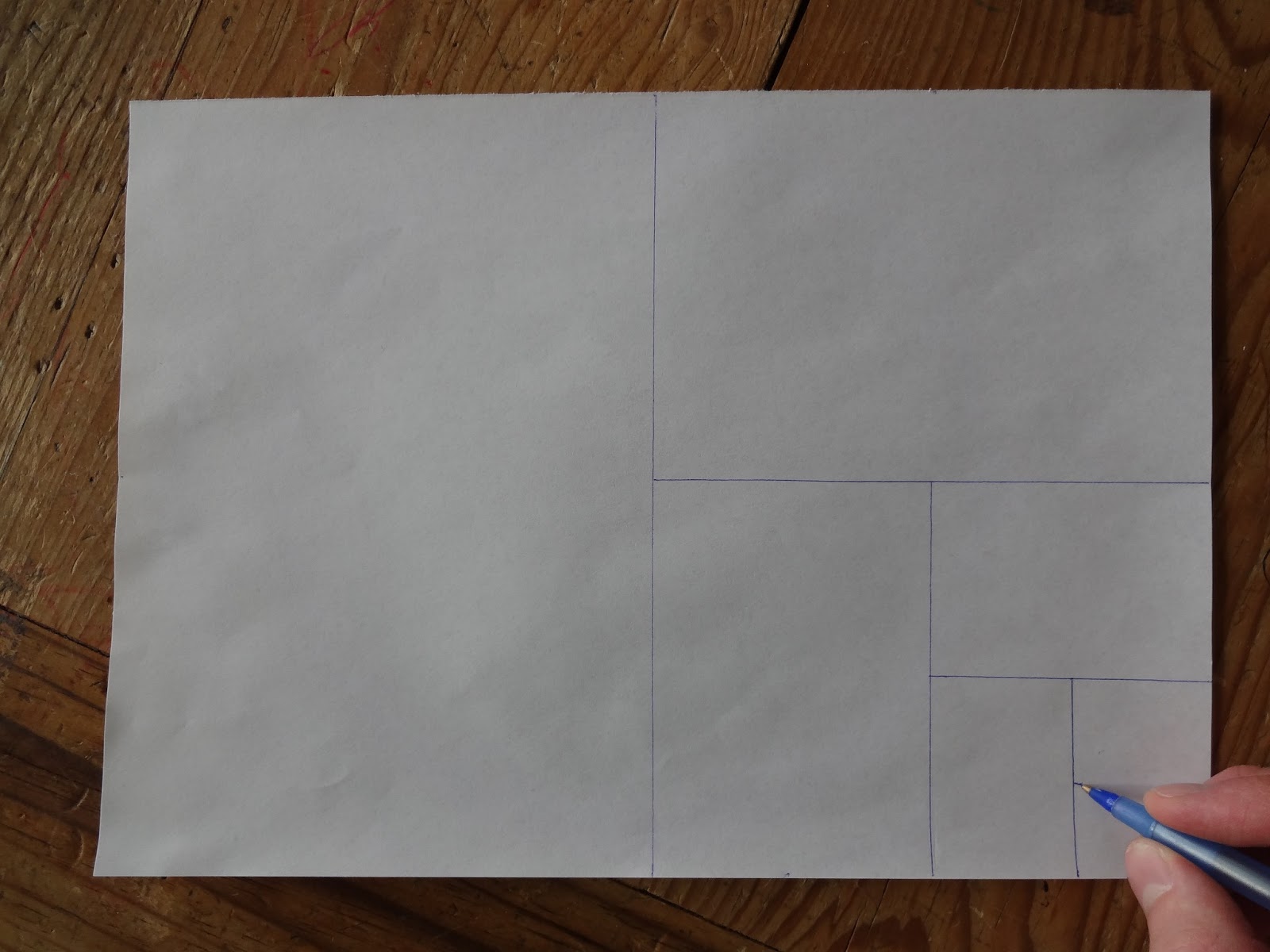
You can use a pen, instead of scissors, to halve the paper.
Those rectangles all have the same shape, but are different sizes.
One night when I was 12, I thought about my idea. I wondered if it was possible to have a sheet of paper that could be cut in half, resulting in 2 smaller versions of the same paper. That would be neat, to be able to cut a paper in half and get 2 papers that had the same exact shape. If that were possible, then you could cut those papers, too; and the resulting papers would have the same shape as all the other papers. You could keep cutting in half forever, and each paper, no matter how small, would have the same shape as all the others.

I HAD to figure it out. Was it possible, or not? I took a pen (or pencil, I don't remember) and a sheet of paper, and began writing. In a few minutes of working with math and numbers, I found that it was possible. I had the solution right in front of me.

The puzzle is this: what could the dimensions for the paper be?

New posts every month - subscribe for free!

Monday, March 11, 2013

The Journey Home


We got back home from our trip to Arizona about a week ago.

Instead of driving back the way we came, we drove through New Mexico, so I didn't get to see the Grand Canyon again. But I got to see parts of New Mexico I hadn't seen before. Here are some photos, listed in chronological order:

Sunday, March 10, 2013

Common Arizona Cacti


When referring to multiple cactus plants in the English language, some say "cactuses", others say "cacti", and a few don't change anything and just say "cactus". All are acceptable, but I prefer to say "cacti".

Cactus plants are very common in Arizona. They are specially adapted to the dry climate; some types can live through up to 10 years of drought. Their green, fleshy stems are often ribbed, making it easier to expand to hold water. The majority have sharp spines, instead of leaves; photosynthesis occurs in the stems. The spines only grow from areoles, which all cacti have.

The largest type of cactus in Arizona is the Carnegiea gigantea, or "saguaro" (suh-wah-ro). If you saw this type of cactus, you would remember it more easily than any others. It gets so tall when mature that none of the other cacti can even start to compare; mature saguaros dwarf even the tallest men.


There are many other types of cacti besides the Saguaro in Arizona, but here are the few you'd be most likely to see:

Friday, March 1, 2013

Arizona-Sonora Desert Museum


On Monday we visited the Arizona-Sonora Desert museum, which is just west of Tuscon. It's like a zoo, but there are a lot of things besides animals there - like meteorites, caves, and plants.

Western Screech-Owl
To the left is a Western Screech-Owl. The handler for this bird said the owl doesn't actually screech, and the name isn't accurate.

American Kestrel
On the right is a live male American Kestrel. Notice that the handler is wearing a glove to protect his hand from the sharp talons. In the wild, those talons are used for killing prey. This particular bird has never used its talons on live prey, however. It was born in captivity, and has never been fed anything alive. Because of this, the bird hasn't developed the skills it needs to survive alone in the wild.
Here's a Harris's Hawk. Notice how much larger it is than the Kestrel:

Wednesday, February 20, 2013

Meteor Crater


After we visited the Grand Canyon, we visited Meteor Crater, a ¾ mile wide impact crater in a northern Arizona desert. It is said to be the best-preserved crater in the world.

In this photo, you can see the crater's bumpy rim
on the horizon.
Scientists believe that Meteor Crater was formed 50,000 years ago by a meteorite only 50 meters wide. It blasted such a large crater because it moved at a rate of something between 37 and 60 times the speed of sound. That's very fast. When the meteor hit the ground, it gave off energy equivalent to 10 - 20 million tons of TNT.

The meteorite became extremely hot when it hit. It became so hot that most of it was vaporized, and the rest melted. The ground where it hit was no more fortunate; it vaporized and melted, too. A large quantity of material was thrown away from the site, and rained onto the ground for miles around.

After the impact, fragments of the meteorite that had broken off in mid-air fell out of the sky onto the ground. Due to higher air resistance, they fell at a much lower velocity than the main meteorite, so they survived impact. Some of those fragments are on display in the museum next to the crater.

When we visited Meteor Crater, the wind was very, very strong with nothing out in the flat desert to stop it. At the edge of the crater, the wind was intensified as it blew up and over the rim. The fee was more than we had expected - $16 for adults, $8 for kids. When my mom had visited the crater for the first time many years ago, the fee had only been $1. I didn't want to turn around without viewing the crater, so my mom paid the money and we went in.

The middle observation deck, about ⅔ up the crater wall.
It wasn't as much of a rip-off as we originally thought. Admission to the museum was included, and there was a short movie followed by a presentation. I had planned on going down into the crater, but it was off-limits for reasons of preservation and liability; plus, the sides of the crater were steep, and the wind was blowing very hard. So instead, I satisfied myself with looking through the telescopes on the observation decks.

A mine shaft. You can also see a 6 ft astronaut cutout and flag if you
look closely; those are memorials of NASA's training in the crater.
In the picture to the right, you can see some old equipment and light-colored soil. Here's why it's there: in the early 1900's, Daniel Barringer tried to find the meteorite that had excavated the crater. He thought the meteorite was as large as the crater, and wanted to sell the metal from it. For 27 years he searched by drilling into the ground, but he never found anything worthwhile. The soil, I presume, is from his drilling, and it's probably the same with the equipment.

I find Meteor Crater very impressive; it is the mark left by an event that released an enormous amount of energy all on a small place in an instant, wreaking havoc and destruction. Yet it shows how even the most powerful and significant events can fade and disappear, while everything continues on as if it never happened - the only memory of the disaster being a hole in the ground.

For the next post in the Arizona Road Trip series, go to http://greatmst.blogspot.com/2013/03/the-desert-museum.html