Pages

Showing posts with label hobby. Show all posts

Wednesday, June 1, 2016

Spring Skiing


Nothing beats a nice spring day on the slopes. The warm sun beams down, with its barely-filtered UV rays piercing through the thin air and frying all unprotected skin. The snow starts out icy, but before long it becomes soft and smooth, with slushy snow flying out at every turn. The weather can be really crazy - a couple years ago, Vail reopened for an extra weekend after closing when it was hit with a snowstorm that dumped 3 feet of snow.


Vail EpicMixOne of the best Spring skiing days I've ever experienced was nearly two months ago at Vail, a week before the closing date. Due to some lucky weather events, I experienced all three main types of snow conditions in a single day: ice, slush, and powder.


The day started out like any other: hard snow covered the trails, frozen solid from the cold night before. Turns were difficult to make on this surface, as the skis could not carve on the ice. Clouds covered the sky. It was cold, but not frigid.

Friday, January 22, 2016

2015 in Photos

Cumulus over a sunset

First off, apologies for this long-overdue post. I've had a busy month, and although I would have liked to post this within a few days of the beginning of 2016, I wasn't able to get it done until now.

2015 was a great year, and I think the images in this post will reflect that. In the previous year's image collection (click here to view), the images were only photographs. The image editing was restricted to cropping; I didn't need anything more. In this collection, though, I have drawings, CGI, and microphotography. These new types of images required more processing to prepare them for viewing. Of course, I used GIMP. I can't afford to pay for software.

Instead of listing tons of images, I picked out the most important ones. I also tried not to add the images from previous blog posts; the majority of what follows is new stuff. I also attempt to analyze the images from both a scientific and artistic standpoint.

Monday, November 9, 2015

Ski Lift

Keystone on opening day
Keystone Ski Resort just opened for the ski season on Friday. I went up to the resort that same day. There was only one run open (not including the beginner area at the top of the mountain), but it was awesome nevertheless!

One of the main downsides to skiing on opening day is the number of people. There must have been about 2500 people on the mountain at the same time as me (not including the people snacking in the lodge).

To keep the lines moving, the lift attendants made sure that the lift was completely full, with 4 people per chair. Even so, the wait to get on the lift took a long time.

At one point when I was standing in line, a thought came to mind: the line was constantly being filled with more and more people, but it never got longer because the chair lift was carrying the people away at the same rate. So what would happen if the lift attendants only put 3 people on each chair, instead of 4? This would disrupt the balance: the inflow of skiers would be greater than the outflow, so the lines would start getting longer. But after a few minutes, the inflow of skiers would decrease (because not as many people would be coming down the mountain), and the lines would stabilize.

The point at which the line stabilizes depends on the number of people on each chair going up.

When I got home, I decided to calculate exactly how many people would be standing in line, based on the number of people per chair. The problem is that there were 2 lifts running, so to simplify the problem, I only looked at a single chair lift: Montezuma Express. I also assumed that half of the people preferred Montezuma Express (rather than the other lift). This makes the total number of people 1250, instead of 2500.

To solve the problem, I started by looking up some details for Montezuma Express. I found the following information at http://www.skilifts.org/:

Type:High-speed quad
Vertical rise:1589 ft
Inclined length:6213 ft
Speed on line:1000 fpm
Number of chairs:168

Now the number of people in line is going to be the total of 1250 minus the number of people on the slopes, minus the number of people going up the lift.

Let x be the number of people per chair. Half of the chairs, 84 chairs, are going to have people on them (because the other half come down the mountain empty). That accounts for 84x people.

Now how many people are skiing down the mountain? Well, that depends on the rate that people are getting off the lift at the top. This, in turn, depends on how many chairs arrive per minute. The distance between the chairs is 6213 ft / 84 = 74 ft, and the speed of the chairs on the line is 1000 ft per minute, so the chair arrival rate will be (1000 fpm) / 74 ft = 13.5 chairs per minute. This means that the number of people getting off the lift at the top will be 13.5x per minute. Assuming it takes n minutes for the average skier to ski to the bottom, there should be 13.5nx skiers on the ski runs.

Using all these new values, there will be 1250 - 84x - 13.5nx people standing in line. How does this affect the minutes spent waiting in line? Just divide by the outflow rate: (1250 - 84x - 13.5nx)/(13.5x).

Ski resort chair lift
Taken Friday at Arapahoe Basin
That was pretty easy. Now let's try plugging in some values. Assuming that the average skier takes 10 minutes to ski down from the top, and that there are 4 people on every chair, the number of people standing in line will be 1250 - 84*4 - 135*4 = 374, and the time spent waiting in line will be 374 / (13.5*4) = 6.9 minutes.

If the attendant only put 3 people on each chair, then there will be 593 people in line, and the wait will be nearly 15 minutes. This is more than twice as long as when there were 4 people on every chair. I think it's pretty clear how important it is to fill every chair going up! (Incidentally, after a few runs, we got tired of the long lines and went to Arapahoe Basin. It wasn't much better...)

Now suppose there's a lodge at the top... and the number of people in the lodge depends on the amount of time spent waiting in line. Suppose that the number of people in the lodge will be 500 + 10t2, where t is the time spent waiting in line at the bottom. How does this affect the number of people waiting in line? I'll leave this for you to figure out!

New posts every month - subscribe for free!

Tuesday, October 13, 2015

CGI Sphere

Over my fall break (which lasted 1 day), I wrote a JavaScript program that would render a sphere. I thought it would be a fun way to practice math and programming skills simultaneously. As usual, I used my FireTools.js library to help with graphics as well as some other functions.

To render the sphere, I wanted to take every pixel on the screen, and calculate the color of the pixel. The color would vary depending on which part of the sphere the pixel was displaying. If the part of the sphere was facing the light source, it would need to be brighter than a part of the sphere facing away from the light source.

Monday, June 29, 2015

Chalk Illusions

I have some crazy news! I was radiated by some radiation, and became radioactive. Over time, my radioactiveness decreased, and as it decreased, my mass decreased as well. I am now a foot shorter than I used to be, and weigh 50 pounds less! At the top of this post, you can see a picture which proves it. In the photo, I'm sitting on a weird box that materialized in the middle of the road...

Monday, June 8, 2015

CG Earth

Click to view larger

You may have noticed that my blog background changed a couple days ago. I've been meaning to change it for quite a while, but I didn't get around to it. Then, a few days ago, I had some free time on my hands. Why not create a 3D model of Earth, I wondered? So I pulled up Blender (a free computer graphics program I use) and got to work.

Thursday, April 16, 2015

Nature GIFs

White blossoms animated gif
I recently created a couple of nature-themed animated GIFs. (Click the images to view larger.)

The first image is a blossoming tree. I thought the tree looked pretty, but I realized that part of the beauty came from the gentle swaying in the wind. So I decided to animate the image.

Saturday, February 28, 2015

Snowflake Photos


In this post, I'm including some of the photos of snowflakes I've taken over the past few days. As usual, these close-ups were taken using my macro setup. I did not edit the photos in any way.

Thursday, January 8, 2015

2014 in Photos

The year of 2014 is over; the year of 2015 has begun. Over the past year, I took a lot of pictures - more than 1200 photos of clouds, bugs, plants, rocks, and more. I deleted most of the low-quality and repetitive photos. Then, I selected 20 of the remaining photos which I thought were the most interesting or significant.

In this post, I'll include those photos, in chronological order.

Wednesday, December 31, 2014

Ultra-Macro Photography Upgrade


Some people pay hundreds to be able to photograph tiny subjects such as snowflakes, but now you can do it for $5.

Friday, August 8, 2014

Feeding Hummingbirds


It's that time of the year when I get the most hummingbirds at my feeder. It's hot, and the fields are brown, but the little whirring birds make summer fun the whole season long.

Saturday, February 8, 2014

2013 in Photos

I know it's already February, but I wanted to post some of my favorite photos I took last year. This post will include those photos, along with some commentary under each one. None of the photos have been posted in previous posts, so you won't have to see any repeats. I took all of the photos in this post using the same camera.

Friday, May 24, 2013

Skim a Pond


Last Friday I went skiing at Arapahoe Basin. Yes, there's still snow up there - but the warm weather is melting it, resulting in conditions known as Spring skiing. The water from the melted snow collects in valleys and trenches, forming ponds excellent for skimming.

Skimming is skiing on water. To skim a pond, the upward force from the skis must exceed the skier's weight, and it must continue to exceed his weight until the skier gets across the pond. The force is determined by the skier's forward velocity, the surface area of the bottom of his skis, and the angle of his skis.

On Friday when I visited Arapahoe Basin, I skimmed a few ponds. It's lots of fun, as long as you don't slow down too much halfway through the pond. Here's a video from my trip:

Friday, November 9, 2012

Pictures from October

These are some of my pictures from October. Some may have been trimmed, but most were not. To see a larger view, click on the image.

First are some pictures of black-billed magpies, one of the most common fall/winter birds where I live:


And here are some contrails. Contrails are the clouds which airplanes leave behind them.

Contrails
The next 3 pictures were taken through some stacked loupes my mom gave me. See if you can figure out what they are.


Now here's a picture of the moon. It was in its waxing crescent phase; "waxing" means "getting larger", and you probably know what "crescent" means.


This is a picture of one of our first snowfalls.


Now a kid in a costume.


Now here are some eggs. You might recognize them from a previous post.


Friday, August 17, 2012

How I Got Blender


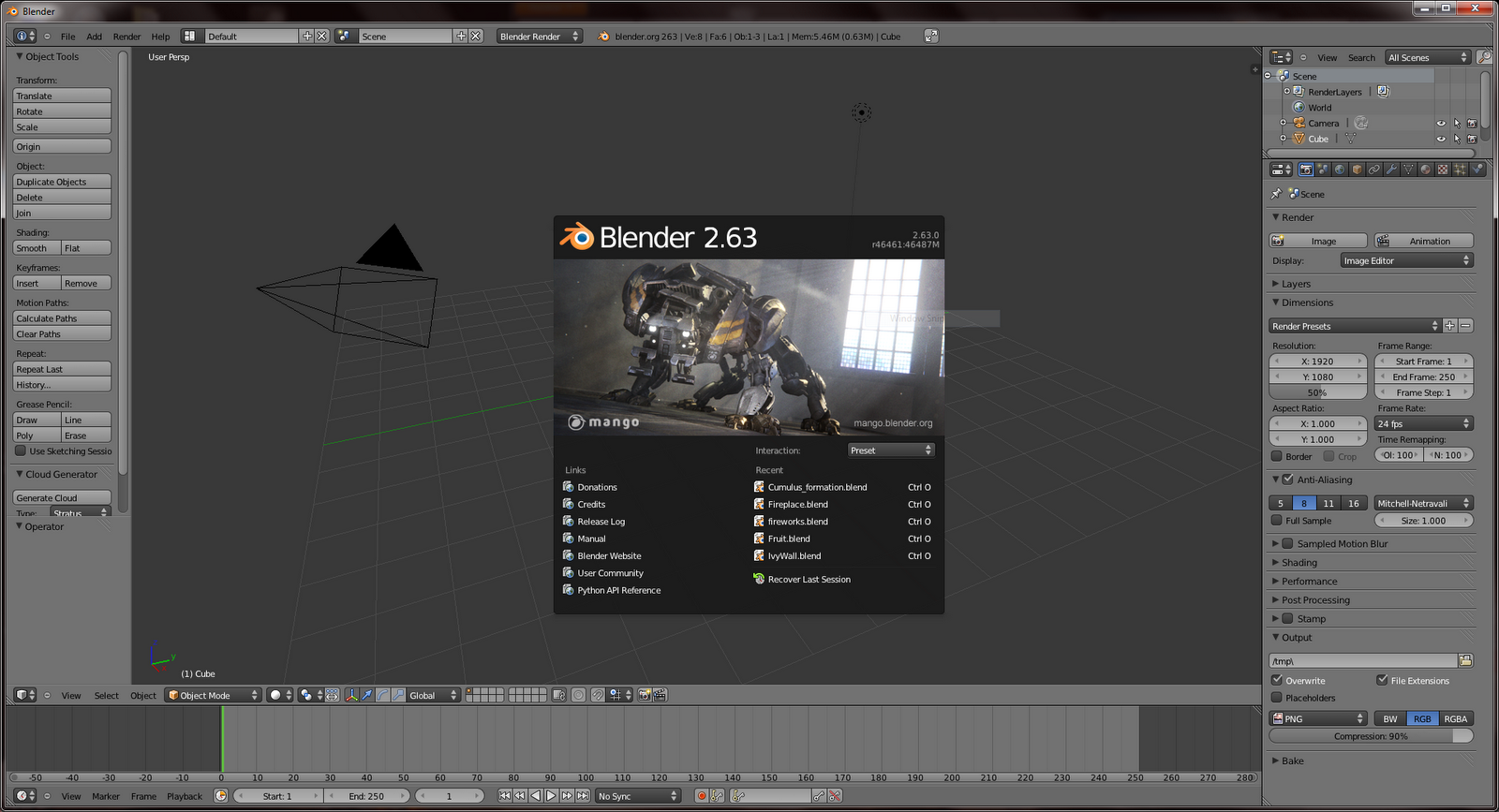
In a couple of my posts, you may notice some computer generated images or animations. They were created with Blender. In this post, I'll explain how I got it and started using it.

A long time ago, I wrote a BASIC program that drew a circle; the user would give the program a number, and it would draw a circle that size. There was a problem, though: the circle had a lot of holes in it. I solved the problem by filling the circle, but that was like cheating. I told my dad about the problem, and he showed me a book about graphics.

I looked through the book, but didn't find anything about my problem. I did find a section with nice, colorful computer-generated images, however - and some were so good they looked like photos! At one point, there was a series showing the construction of a photo-realistic image of a room, starting with the edges, then moving on to the surfaces, texturing, lighting, etc. Here's a similar series I made using Blender (but not photo-realistic):
Edges
Surfaces
Color
Lighting
Bump-Mapping, Reflections, Specularity, and Compositing
It looked so simple, I was hooked. I had to make my own computer-generated image that looked like a photo. I asked my dad to get me some software for 3D animations, so he searched on Google and found Blender. It looked like fun, and it was free, so we got it.

I followed some video tutorials I found on blender.org to make some nice images, and then I started making my own stuff. It was a lot of fun. I raved about it to my sister, but she just got sick of it and hated to even hear the name "Blender." Eventually, though, I convinced her to take a tutorial and make some balloons, and now she uses it to create images, like me. She uses it for art, but I also use it to show people how things work.

So that's how I got Blender. If you're interested in trying it out, just go to the download page on blender.org, and download it. Maybe you'll find it as fun and useful as I do.

Sunday, July 8, 2012

Bird-Watching


Few people watch birds very closely nowadays, or go to any lengths to identify them. That's their loss - bird-watching is fun, educational, and a way to pass the time when you're bored. After bird-watching for a year or two, you can identify birds a lot more easily, and you aren't as clueless when people ask, "What kind of bird is that at your feeder?"

So what do you need to bird-watch? Binoculars are essential; without them, many small markings can be indistinguishable. A field guide is also important. David Allen Sibley's guides are probably best, but anything will work as long as it covers your area thoroughly enough. And that's it. There are other little things that may be helpful, like a camera or a notebook, but these are all you really need.

If you already know a little about bird identification, then you're ready to start looking for birds to identify. But if you're a beginner, you may need a little more help. You might see a large black and white bird land in the snow, and open your field guide to figure out what kind of bird it is. You know the bird you saw must be somewhere in the book, but you don't know where to begin - and it would take you all day to check every single page.

I had the same problem when I first started identifying birds, only the birds were a lot tougher than a Black-Billed Magpie (the black and white bird I just mentioned). I checked the index, only to find a bunch of bird names. That wasn't helpful. I checked everywhere else, trying to find clues as to where I should look in the book. Still no help. In the end, I checked the whole book. I found a few birds that looked like my bird, but the bird was gone so I couldn't compare any more.

What should you do to prevent this from happening?

In good field guides, the birds are grouped according to family, or similar types; the ducks are with the ducks, and the ravens are with the ravens. This makes things simple; once you figure out the family, the possible bird types are greatly reduced.

For beginners, however, determining the family is exactly the problem. If you aren't good at recognizing bird families, try this: look at a lot of pictures of birds, and read about their habitats and behaviors. If you do this, it will make bird identification easier. The longer you spend reading about and studying a bird's characteristics, the more likely you'll be to recognize it when you see it.


Some tips:

- In The Sibley Field Guide to Birds, Sibley has a lot of good rules for birdwatching. Here's a quote: "Practice seeing details. Much of the skill involved in identifying birds is being able to sort out the details of the bird's appearance from a distance."

- Take a notebook with you when you bird-watch. If you see a bird, take notes on the bird's behavior, location and appearance. If you can draw a rough sketch, do that too.

- If you are having trouble identifying a bird, take a few photographs of it. Then you will have a record of it even after it flies away, which can be very helpful.

Swallow
A Violet-Green Swallow in flight
- Sometimes, bird families contain very different-looking birds. Believe it or not, bluebirds are in the same family as robins: both are thrushes. If you run into a family like this, you may wish to break it up and study each genus (a subclass of family) separately.

- Some common bird types to study are: Duck, Finch, Goose, Gull, Hawk, Hummingbird, Pigeon, Swallow, Sparrow. Even if one of them isn't in your area, study it anyway; chances are you'll see it on a vacation.

- When buying binoculars, try them out before you buy them. If you don't, you could end up with something that doesn't focus right, or worse.