Pages

Saturday, October 6, 2012

Khan Academy

In this post, I'll tell you about a really cool new site I found: Khan Academy.

Khan Academy is basically a bunch of free tutorials for school subjects like mathematics, history, science, and just about anything else. And not only that, but they also have a special practice page that offers exercises, and when you complete enough of them you get points.

And here's one of my favorite things about it: they have a special section just for computer science, so I can write programs (mostly video games), and everybody else can see and play them. So far I've only written one program, but it's pretty good for my first (even though it's not finished yet). But one of the coolest things about that programming feature is that you can embed the program on a web page:

Super Ball

Another nice thing is the badges you get for accomplishing certain things. There are 6 types: meteorite, moon, earth, sun, black hole, and challenge. The easiest to get are the meteorites, and the hardest are the black holes (you don't even know how to get the black holes!). The challenge badges are just extra stuff. You can display up to 5 of your badges on your profile page for everybody else to see.

So check it all out - go to www.khanacademy.org! If you ever forget the link, just check my Links page.

Monday, October 1, 2012

A Blue Moon


Blue moon sounds like a moon that's blue. And it can mean that, sometimes. But that's not the real definition.

By the calendar, a blue moon is the second full moon of a month. The original definition (a seasonal blue moon) is the 3rd full moon in a season that has 4 full moons. Either way, a blue moon occurs approximately every 2.68 years.

The full moon of August 31st, 2012 was a blue moon by the calendar. I had to see it, because I won't see another for at least 2.68 years (I'll see a seasonal blue moon in August 2013, though). So I got a camera and a tripod and headed outside.

It was warm, and everything cast shadows from the moon's light. The first thing I did was to set up my camera and tripod and point it at my house. After changing the camera's settings, I took a picture. Here's what I got:

Tuesday, September 4, 2012

Guess the Details

Here are some pictures I took. See if you can guess some things about the photos:
  1. Approximately what time of day the photo was taken at, or if it's computer-generated
  2. Which parts of the photo were computer-generated, if any
  3. The season (for outdoor photos)
To view the images better, click on one. I'll give answers later.

House

Crayons

Calendar Blue Moon
Weeds and Grass

Saturday, September 1, 2012

Mathematically Diving

Diving can be done well or poorly, depending on how good the diver is. Sometimes, beginning divers will do "belly flops", smacking the water horizontally instead of cutting into it like a needle. Whether a dive is a good one usually depends on whether the diver went straight into the water or not. Experienced divers can do this without thinking much about it, as if it were like walking; beginners, however, have a lot more trouble.

In time, people get used to diving; machines, however, can't learn, and are always just as clumsy. If the machine contained a computer, it would need a computer program to help it dive. The program would need to use a math formula. Here's what we'll start out with: v1= v2 tan θ, where v1 and v2 represent forward and downward velocities, and θ is the vertical angle in degrees.


Here's how it works: the forward and downward velocities of a good dive have the same ratio as the sine and cosine of the vertical angle of the diver (represented by θ. See picture), so the formula is v1 / v2 = sin θ / cos θ. Since sin/cos = tan, the formula becomes v1 / v2 = tan θ; multiply both sides by v2, and you get v1 v2 tan θ.

To use the formula, you figure out what angle you'll be diving at and how fast you'll be falling when you hit the water (the downward velocity, v2). When you put those numbers into the equation, you can do the math and get your forward velocity (v1), so you know how fast you have to run off the diving board.

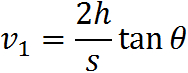
However, you might not know how fast you'll be falling (v2) when you hit the water, so let's calculate it now. If you fell h feet in s seconds, your average speed in the time you fell was h ft per s sec, which is the same speed as h/s ft per sec. Since acceleration while falling is as good as a constant (ignoring air resistance), and you start at zero, your final speed is twice your average speed: 2h/s ft per sec. Insert that into the equation and you get:

Now we have another problem: s, the amount of time before you hit the water. To get rid of s, we just need to state it in terms of another variable. After falling for 1 second, your speed will be 32 ft per sec. After s seconds, your speed will be 32s ft per sec. We also know that your speed will be 2h/s ft per sec. Therefore, 2h/s = 32s. Work it out and you get s = √h / 4. The very complicated equation you see to the right is what we have now. And if we simplify it, we get the final equation you see below.


Saturday, August 25, 2012

"Flipping Quarters" Solution

A couple of pieces of good news: First, in this post will be the answer to the problem I gave called Flipping Quarters; and second, I'll even work through the solution!