Here's a simple physics puzzle: suppose you're launching a model rocket. You want the rocket to go as high as possible. Is it better to design the rocket to:
A. Use all of its fuel very quickly, and then use its momentum to travel high
B. Use the fuel gradually over the whole duration of the flight
In other words, what is the fuel consumption rate that will maximize the height of the flight path? For this problem, we can assume that the thrust is proportional to the fuel consumption rate.
I'll try to post a solution to the problem in the future.
New posts every month - subscribe for free!
Showing posts with label puzzle. Show all posts
Showing posts with label puzzle. Show all posts
Monday, February 29, 2016
Friday, December 18, 2015
Gravity

The answer to this question requires a basic understanding of gravity.
Monday, November 9, 2015
Ski Lift
 |
| Keystone on opening day |
One of the main downsides to skiing on opening day is the number of people. There must have been about 2500 people on the mountain at the same time as me (not including the people snacking in the lodge).
To keep the lines moving, the lift attendants made sure that the lift was completely full, with 4 people per chair. Even so, the wait to get on the lift took a long time.
At one point when I was standing in line, a thought came to mind: the line was constantly being filled with more and more people, but it never got longer because the chair lift was carrying the people away at the same rate. So what would happen if the lift attendants only put 3 people on each chair, instead of 4? This would disrupt the balance: the inflow of skiers would be greater than the outflow, so the lines would start getting longer. But after a few minutes, the inflow of skiers would decrease (because not as many people would be coming down the mountain), and the lines would stabilize.
The point at which the line stabilizes depends on the number of people on each chair going up.
When I got home, I decided to calculate exactly how many people would be standing in line, based on the number of people per chair. The problem is that there were 2 lifts running, so to simplify the problem, I only looked at a single chair lift: Montezuma Express. I also assumed that half of the people preferred Montezuma Express (rather than the other lift). This makes the total number of people 1250, instead of 2500.
To solve the problem, I started by looking up some details for Montezuma Express. I found the following information at http://www.skilifts.org/:
| Type: | High-speed quad |
| Vertical rise: | 1589 ft |
| Inclined length: | 6213 ft |
| Speed on line: | 1000 fpm |
| Number of chairs: | 168 |
Let x be the number of people per chair. Half of the chairs, 84 chairs, are going to have people on them (because the other half come down the mountain empty). That accounts for 84x people.
Now how many people are skiing down the mountain? Well, that depends on the rate that people are getting off the lift at the top. This, in turn, depends on how many chairs arrive per minute. The distance between the chairs is 6213 ft / 84 = 74 ft, and the speed of the chairs on the line is 1000 ft per minute, so the chair arrival rate will be (1000 fpm) / 74 ft = 13.5 chairs per minute. This means that the number of people getting off the lift at the top will be 13.5x per minute. Assuming it takes n minutes for the average skier to ski to the bottom, there should be 13.5nx skiers on the ski runs.
Using all these new values, there will be 1250 - 84x - 13.5nx people standing in line. How does this affect the minutes spent waiting in line? Just divide by the outflow rate: (1250 - 84x - 13.5nx)/(13.5x).
 |
| Taken Friday at Arapahoe Basin |
If the attendant only put 3 people on each chair, then there will be 593 people in line, and the wait will be nearly 15 minutes. This is more than twice as long as when there were 4 people on every chair. I think it's pretty clear how important it is to fill every chair going up! (Incidentally, after a few runs, we got tired of the long lines and went to Arapahoe Basin. It wasn't much better...)
Now suppose there's a lodge at the top... and the number of people in the lodge depends on the amount of time spent waiting in line. Suppose that the number of people in the lodge will be 500 + 10t2, where t is the time spent waiting in line at the bottom. How does this affect the number of people waiting in line? I'll leave this for you to figure out!
New posts every month - subscribe for free!
Sunday, August 30, 2015
Word Puzzle
I'm thinking of two common English words, W1 and W2. W1 is half as long as W2, but has twice the syllables. When combined, the two words form a phrase that can be used to refer to a nonspecific stage of a meal.
The letters in these two words can be rearranged to form two new common words: W3, and W4. W3 is half as long as W4, and it also has half the syllables. The two words, when combined, may be used when telling somebody to draw with a certain art medium.
What are all four words?
New posts every month - subscribe for free!
The letters in these two words can be rearranged to form two new common words: W3, and W4. W3 is half as long as W4, and it also has half the syllables. The two words, when combined, may be used when telling somebody to draw with a certain art medium.
What are all four words?
New posts every month - subscribe for free!
Wednesday, August 5, 2015
Which Hurts More?
 |
| 212° F |
1.
(a) Stick your hand in the oven
(b) Stick your hand in the boiling water
... for a period of 10 seconds
2.
(a) Leave a fork in the oven
(b) Leave a fork in boiling water
... for a period of 15 minutes. Then hold the fork tight with your bare hand.
3. Fill a jar to the top with cool tap water. Then:
(a) Place the jar in the oven
(b) Place the jar in the boiling water
... for a specific, but unknown, period of time. Then remove the jar and put your hand in it.
First see if you can figure these out yourself. They shouldn't be too hard. If you have trouble, heat up your oven and boil a pot of water, and see for yourself what hurts more. (NOTE: I take no responsibility for any resulting injury.)
Saturday, March 30, 2013
Dividing Paper Puzzle

When I was young, I would fold a sheet of letter paper in half, for origami projects. It occurred to me that the two halves looked almost the same as the whole sheet of paper - except they were smaller. I could see they weren't exactly the same shape; they were off by a little bit. But the idea stuck in my head.
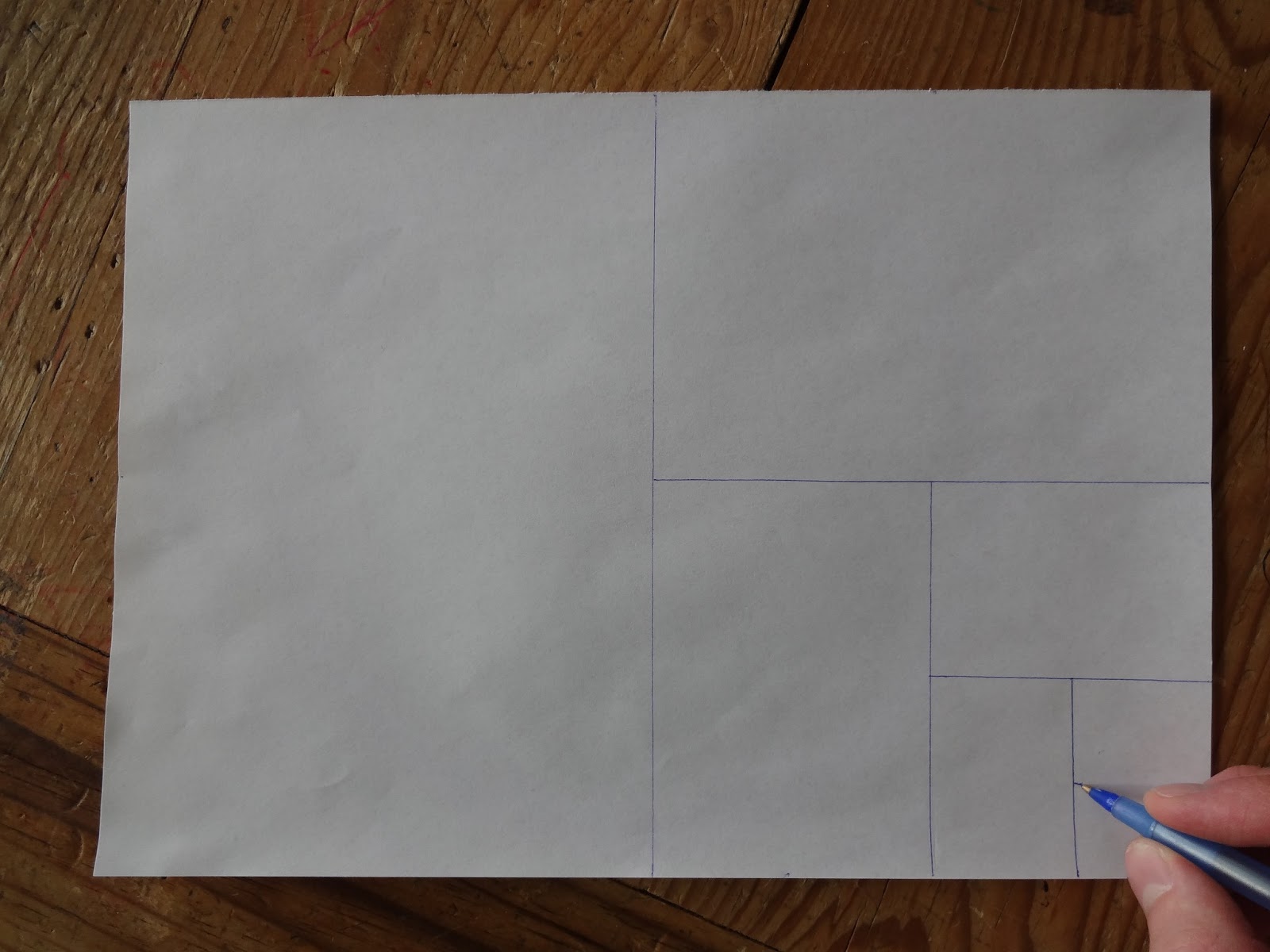 |
| You can use a pen, instead of scissors, to halve the paper. Those rectangles all have the same shape, but are different sizes. |
One night when I was 12, I thought about my idea. I wondered if it was possible to have a sheet of paper that could be cut in half, resulting in 2 smaller versions of the same paper. That would be neat, to be able to cut a paper in half and get 2 papers that had the same exact shape. If that were possible, then you could cut those papers, too; and the resulting papers would have the same shape as all the other papers. You could keep cutting in half forever, and each paper, no matter how small, would have the same shape as all the others.
I HAD to figure it out. Was it possible, or not? I took a pen (or pencil, I don't remember) and a sheet of paper, and began writing. In a few minutes of working with math and numbers, I found that it was possible. I had the solution right in front of me.
The puzzle is this: what could the dimensions for the paper be?
New posts every month - subscribe for free!
Tuesday, September 4, 2012
Guess the Details
Here are some pictures I took. See if you can guess some things about the photos:
- Approximately what time of day the photo was taken at, or if it's computer-generated
- Which parts of the photo were computer-generated, if any
- The season (for outdoor photos)
 |
| House |
 |
| Crayons |
 |
| Calendar Blue Moon |
 |
| Weeds and Grass |
Saturday, August 25, 2012
"Flipping Quarters" Solution
A couple of pieces of good news: First, in this post will be the answer to the problem I gave called Flipping Quarters; and second, I'll even work through the solution!
Tuesday, August 7, 2012
Flipping Quarters
Here's an interesting puzzle involving chance:
 A man in a park asks you to play a game with him. It's a form of gambling. To play, you must pay the man $5, then flip a coin repeatedly until you get heads. As soon as you get heads, you stop flipping. If you only flipped the quarter once, he'll give you $1. If you flipped it twice, you get $2. Three times, $4. Four times, $8. Each extra flip gets you twice as much money, so the longer it takes before you get tails, the more money you get.
 A man in a park asks you to play a game with him. It's a form of gambling. To play, you must pay the man $5, then flip a coin repeatedly until you get heads. As soon as you get heads, you stop flipping. If you only flipped the quarter once, he'll give you $1. If you flipped it twice, you get $2. Three times, $4. Four times, $8. Each extra flip gets you twice as much money, so the longer it takes before you get tails, the more money you get.
Should you play, if you have a lot of time and the man will play as many games as you want? How much money, on average, would you gain (subtracting the $5 fee)?
I will give the solution in a later post.
I will give the solution in a later post.
Subscribe to:
Posts (Atom)