Pages

Tuesday, May 7, 2013

Warm Weather


Finally - it's nice and warm outside. The meadowlarks are singing, and cumulus clouds fill the sky. In some places, this kind of weather has been going on for the past couple of months. Where I live, though, we've been having cool weather, so a 70° day seems very warm.

Here are some of the pictures I took today:

Monday, April 29, 2013

Sprout Jar

Photos of seeds from yesterday, to scale.
The onion is the one on the left.
A couple of days ago I planted 3 seeds in a clear glass jar, so I could watch them germinate. 2 of the seeds came from one of my basil plants, and the other came from a green onion plant. This is partly a test on the quality of my home-grown seeds, but also a fun gardening activity; after all, who wouldn't like to sprout  some seeds and watch them grow?

Here's how you can make your own sprout jar:

Tuesday, April 23, 2013

Halbach Array

Yesterday I learned about something really cool called a Halbach array. It's a special arrangement of magnets that has a magnetic field on one side, but not the other.

The array and its effect were discovered in 1973 by John C. Mallinson, but it was named after physicist Klaus Halbach, who invented the array 7 years later - not knowing someone else had already gone to the trouble.

Halbach array, showing approximate field lines.
The way the Halbach array works is similar to a bunch of lined up horseshoe magnets. There are North and South poles, but they are all on the same side of the row. Horseshoe magnets are clumsy, so in the Halbach array, regular bar magnets are used instead. The magnets are oriented so that their magnetic fields match those of the horseshoe magnets they're replacing; that way, the effect is nearly the same.

A perfect Halbach array is only magnetic on one side, greatly reducing stray magnetic fields that can interfere with other equipment; and since the magnetic field is all on the same side, it is twice as strong as a regular magnet's field. Because of those properties, Halbach arrays are useful in a variety of applications, including:
  • Refrigerator magnets
  • Inductrack Maglev train system
  • Particle accelerators
  • Free electron lasers
Then there's the Halbach cylinder, where the magnetic field is in a bore down the center, and the Halbach sphere, where the magnetic field is in an empty spot inside the sphere. They aren't as simple as the array, so I won't explain them in this post.

Monday, April 15, 2013

Water Balls


One day in Arizona, I made pancakes. The pans were a little different than I was used to; I normally use a buttered cast-iron skillet to fry my pancakes, but the apartment we were staying in didn't have any of those. As far as pans went, all they had were stainless steel frying pans - which are very different from cast-iron skillets.

Saturday, March 30, 2013

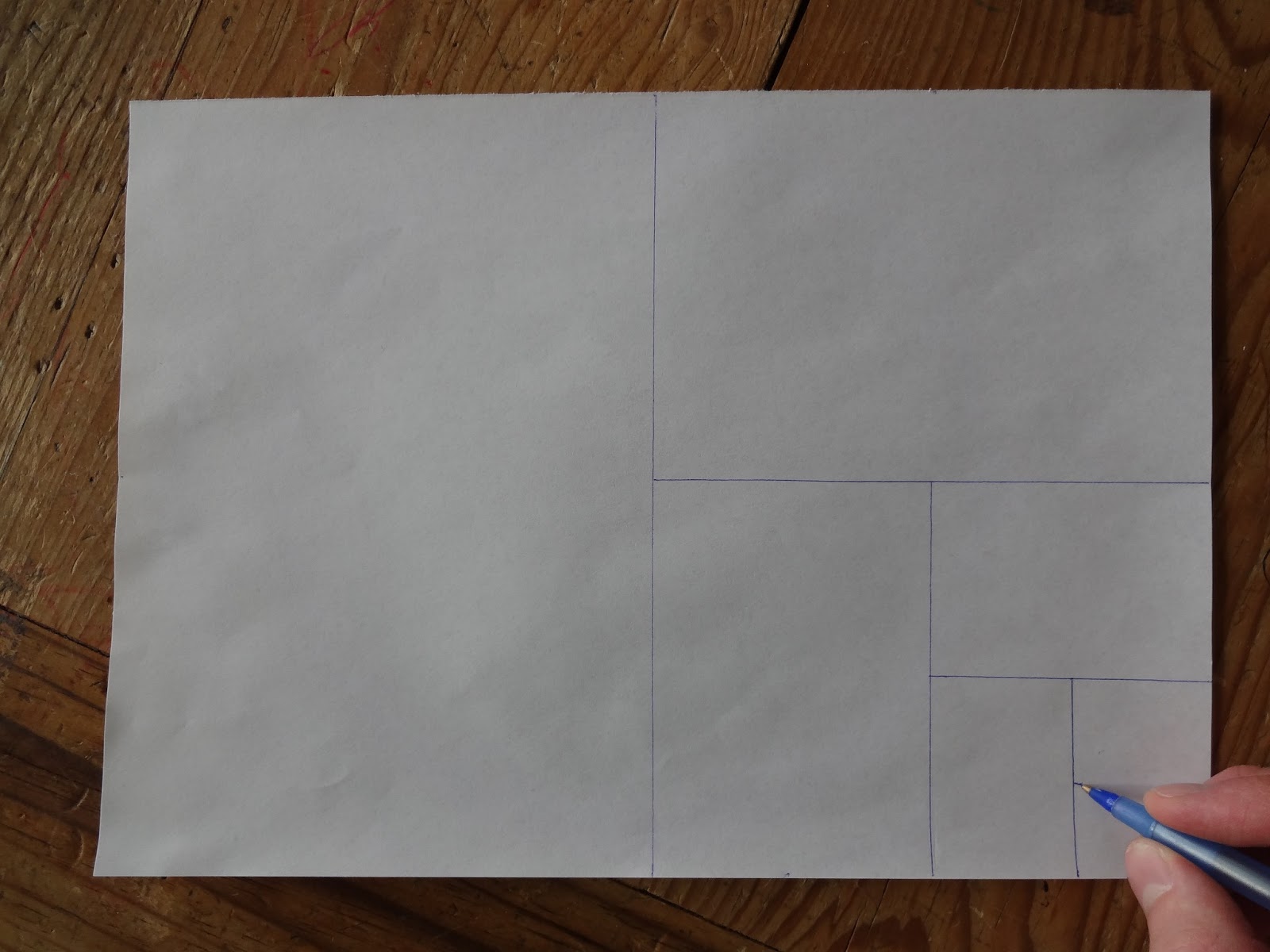
Dividing Paper Puzzle


When I was young, I would fold a sheet of letter paper in half, for origami projects. It occurred to me that the two halves looked almost the same as the whole sheet of paper - except they were smaller. I could see they weren't exactly the same shape; they were off by a little bit. But the idea stuck in my head.

You can use a pen, instead of scissors, to halve the paper.
Those rectangles all have the same shape, but are different sizes.
One night when I was 12, I thought about my idea. I wondered if it was possible to have a sheet of paper that could be cut in half, resulting in 2 smaller versions of the same paper. That would be neat, to be able to cut a paper in half and get 2 papers that had the same exact shape. If that were possible, then you could cut those papers, too; and the resulting papers would have the same shape as all the other papers. You could keep cutting in half forever, and each paper, no matter how small, would have the same shape as all the others.

I HAD to figure it out. Was it possible, or not? I took a pen (or pencil, I don't remember) and a sheet of paper, and began writing. In a few minutes of working with math and numbers, I found that it was possible. I had the solution right in front of me.

The puzzle is this: what could the dimensions for the paper be?

New posts every month - subscribe for free!